BUILTHERITAGE
Stewarded by the City of Edmonton Archives
  • By Time
  • By Place
  • By Story
⌘K
BUILTHERITAGE
Stewarded by the City of Edmonton Archives

Discover the structures, places, and stories that shaped Edmonton's built environment.

Resources

NewsFAQsLinks

Contact

City of Edmonton Archivesarchives@edmonton.ca780-496-8711

We acknowledge that the land on which Edmonton is built is Treaty Six Territory. We thank the diverse Indigenous Peoples whose footsteps have marked this territory for centuries, such as nêhiyaw (Cree), Dené, Anishinaabe (Saulteaux), Nakota Isga (Nakota Sioux), and Niitsitapi (Blackfoot) peoples. We also acknowledge this as the Métis homeland and the home of one of the largest communities of Inuit south of the 60th parallel. It is a welcoming place for all peoples who come from around the world to share Edmonton as a home. It is important that we not only recognize our shared histories, but also each other's contributions to establishing the built heritage of Edmonton and Area.

© 2026 City of Edmonton Archives
Privacy Policy•Terms of Use•Accessibility

Time Periods

Edmonton's heritage story unfolds across distinct eras — from the fur trade forts and early surveyed townships to the boom years of the 1910s, the Depression's enforced austerity, and the post-war building surge that transformed the city. Each period left a visible mark on the built landscape.

Browse structures, stories, and people organized by the historical era in which they emerged, or use the Timeline to move across the full span of Edmonton's built history.

In this collection

Time periods
6Time periods
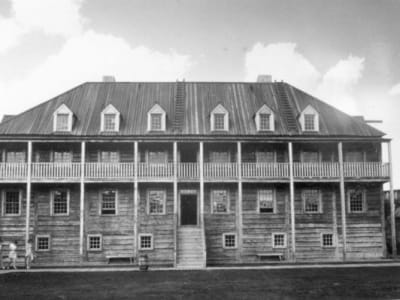
Big House at Fort Edmonton Park, 1975, front elevation.

Pre-contact and Fur Trade

-11000–1870

Indigenous Peoples have called this area home for millennia. Many trace their origin stories to being of the lands of Turtle Island, and denounce other theories of migration. One certainty is that Settlers did not arrive in the West until commerce and the need for raw materials drove them to expand.
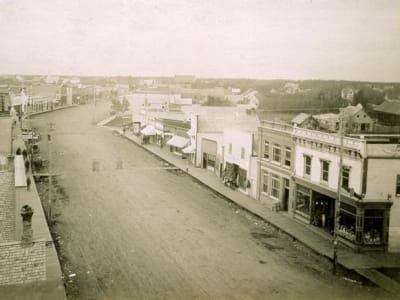
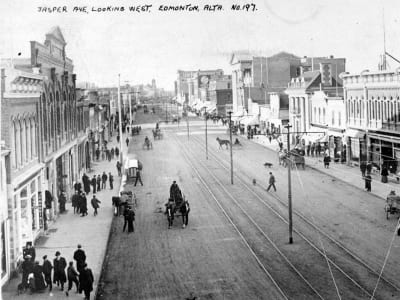
Photograph showing Jasper Avenue looking west in the year 1898.

Urban Settlement

1870–1904

Edmonton as we know it today began to develop in the early 1870s. Initially a very small community, it grew steadily until 1904, at which time it had a population of over 8,000.

Jasper Avenue looking west, 1910. City of Edmonton Archives EA-10-199

Urban Growth

1905–1914

Between 1905 and 1913 Edmonton experienced incredible growth. The population exploded from less than 10,000 to almost 70,000 in only a few years.

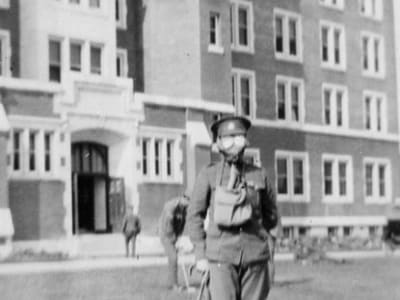
Soldier in front of Alberta College South Veteran's Hospital, circa 1917.

The War Years

1914–1945

Between 1914 and 1945 Edmonton underwent phenomenal change as the Great War, the Depression and the Second World War left their mark.

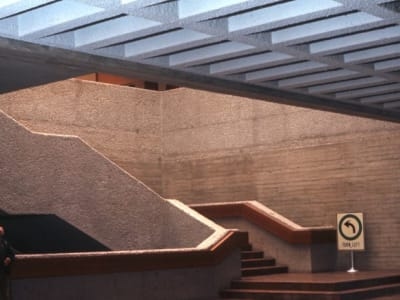
Interior view of the main staircase of the Edmonton Art Gallery taken in 1969.

The Post War Years

1946–1970

The discovery of oil in Alberta changed Edmonton forever. Rapid growth, new technologies and changing lifestyles and world views dramatically altered Edmonton's built landscape.

Image coming soon

Present

1971–2026

Edmonton after the Post War Years — ongoing growth, neighbourhood boundary updates, and modern heritage. Local dev seed for map boundary testing.

Showing 6 time periods